
How Prince won the Super Bowl
On this day in 2007, Prince won Super Bowl XLI with a soaring halftime performance that climaxed with the skies opening up to honor his guitar solo. It is not just the best-regarded halftime show ever, but was to that point the most-viewed musical performance in American history. And it would come to stand as one of the greatest milestones in one of the greatest musical careers of all time.
Prince’s halftime show wasn’t just a fun diversion from a football game; it was a deeply personal statement on race, agency and personal expression from an artist determined to make a definitive statement on his long-term legacy. And he did it on his own terms, as always.
Opening with the signature stomp-stomp-clap of Queen’s “We Will Rock You”, Prince went for crowd participation right from the start, with a nod to one of the biggest stadium anthems of all time — and notably, is one of a few songs in the set that he never performed at any time before or after that day. Indeed, Prince had rarely, if ever, played any Queen covers at all in his thousands of live shows. (Though his more obscure 1992 song "3 Chains O' Gold" is clearly a pastiche of "Bohemian Rhapsody", which was then enjoying a renewed popularity.)
With that arena-rock staple, Prince was sending an unambiguous signal that he was going to win over a football crowd. He launched straight into “Let’s Go Crazy” at the top of the set. As one of the best album- and concert-opening songs of all time, this was a perfect choice. Different from any other Super Bowl performer before or since, Prince actually does a call-and-response section in the song, emphasizing that this is live, and connecting him explicitly to a timeless Black music tradition.
Oddly, though, Let's Go Crazy is also the only of Prince's 5 number one singles included in the Super Bowl performance. In fact, this is a motif with this entire performance — Prince’s setlist was completely unexpected, and inspired. Imagine Michael Jackson doing a halftime set but omitting "Billie Jean", or Springsteen leaving off "Born To Run". This set skips number one hits like "When Doves Cry", "Kiss", and "Cream" and signature songs like "Little Red Corvette" in favor of... a bunch of covers? What is Prince trying to tell us?
For example, next up we get a medley of the opening bars of "1999" leading into "Baby I’m A Star". Of course the two big crowd-pleasing signature Prince hits make sense, but then he quickly moves into a cover of "Proud Mary". This is a surprising choice, as it's not a song that Prince has any obvious or direct connection to. But let's look a little deeper.
Though "Proud Mary" is a Credence Clearwater Revival composition, the definitive version is Tina Turner’s version — and Prince is clearly belting out Tina's version of the song, as is made clear by the backing of his longtime accompanying vocalist Shelby Johnson and the choreography of his dancers Nandy and Maya McClean. This context is key; Ike & Tina Turner were pioneers of rock and roll, and with "Proud Mary" they were in many ways the first to reclaim rock as Black music on the public stage.
There's a more personal note, too. As Prince mentioned onstage a few years earlier, "Proud Mary" was the first song he had ever learned to play on the guitar. Here, he was carrying forward the lessons he'd learned from his parents and the community that had raised him and taught him to play, and showing them that he could elevate their teachings to the biggest stage in the world.
The People of the Revolution
This is a good time to note that half of Prince’s bandmates on his biggest stage ever are, as was common for his bands, women. Most of his bandmates are Black. Prince had been a pioneer in integrating his bands in the 80s, inspired by Sly Stone and other acts who had modeled a fearlessly inclusive vision onstage that Prince would bring to his lyrics and music as well.
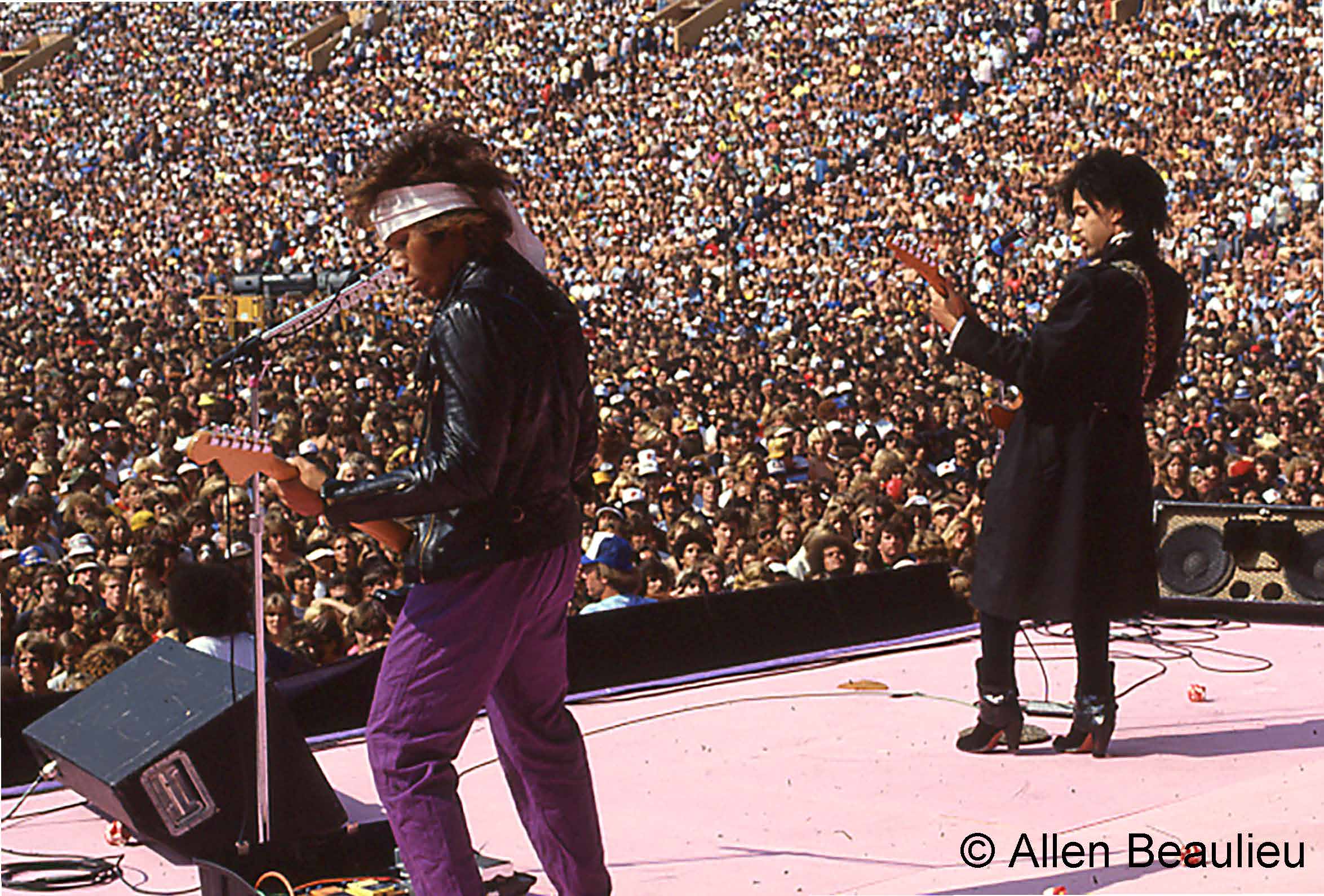
Here it's worth revisiting some history. Prince’s first-ever experience in playing a stadium had been opening for The Rolling Stones in 1981, when their fans had repeatedly unleashed a torrent of racist, homophobic bile at Prince and his band, hounding them from the stage by throwing objects and garbage at the band. From that performance on, Prince never opened for another act, instead preferring to play on his home turf — a stage he controlled, in a show he headlined. He had a well-earned reluctance to make himself vulnerable by performing on any terms that weren’t his own.
The androgyny of Prince's image in the 1980s earned him a large gay and queer audience, especially as the prominence of Revolution band members Wendy Melvoin and Lisa Coleman (who were a couple at the time, though they didn't officially come out until years later) grew. But Prince was well aware of the era's conservatism, as he alluded to in his 1980 album and song "Controversy". This makes it likely that opening with a nod to Queen wasn't just appreciating that their 1985 Live Aid set had been heralded as one of the greatest live rock performances of all time, but also the shift in appreciation of one of the great queer front men in the history of rock, a stark contrast to the brutal reception Prince had seen at that Rolling Stones show a few decades prior.
Prince also had an aversion to big events that were corny or clichéd, and for many years, that's why he had declined to do the Super Bowl. (It probably played no small part in his reluctance to participate in the "We Are The World" recording session in the 80s, a decision that was perhaps his most harshly-critiqued choice during his period of peak commercial success.) This time, though, Prince clearly wanted to do the show his way, and to bring the audience along with him in defining and claiming his place in music as an elder statesman of rock music. That elder statesman status had recently become official with another legendary performance during his induction into the Rock & Roll Hall of Fame.
As befit his new status, Prince was doing the work to ensure that the show went perfectly. In an uncharacteristically accommodating move, Prince even went along with all of necessary machinations surrounding the Super Bowl. He did a commercial (!) that was sponsored by Pepsi. He sent a rehearsal recording of a few of the songs from the set to Howard Stern to preview on his show ahead of the big game. He even did a press conference for media, like other halftime performers. Only, well... he did it Prince-style. Check out how he responded as soon as reporters fired off their first questions:
Taking the stage by storm
And so, having earned his place on this stage, Prince tells his story. Notice that, right near the start of his set, Prince brings out the Florida A&M University's Marching 100. As we saw later in Beyoncé's Homecoming, there’s a profound power in recontextualizing familiar pop hits within the unique musical (and on-field!) tradition of HBCUs. This is also another sign of the statement about Black artistry that Prince is making with his entire set.
Prince then launches into a medley of Bob Dylan's "All Along The Watchtower" and the Foo Fighters' "The Best Of You". "Watchtower" is a deep choice here: Bob Dylan is really the only other artist who is as key to Minnesota music history as Prince, and the definitive version of the song is Jimi Hendrix's — an artist whose impact on Prince is undeniable (if at times overstated). The important thing here is what Jimi did. "All Along the Watchtower" is another song, the second of this short set, that was written by a white artist and then definitively cemented in rock and roll history by a Black artist. And this time, both the composer and signature performer are artists whose names were brought up in discussions of Prince for his entire career.
The very word "Watchtower" also evokes Prince's deep identity as a Jehovah's Witness; this was a time in his life when he was literally going door to door witnessing his faith. While it may have been something of a subtle nod, it's impossible to think that Prince didn't have that connotation at least in the back of his mind.
Okay, but why a Foo Fighters cover? One reason is clearly Prince’s playful love/hate relationship with artists covering his work. Though Prince liked and respected (and jammed with!) Dave Grohl, he also bristled whenever his songs were covered without explicit permission.
More significantly, just a few years prior, the Foo Fighters had gotten an alternative radio hit out of their cover of Prince’s ”Darling Nikki”. But those same stations had never added Prince’s guitar-driven hits to their playlists, even as they featured artists who explicitly credited him as an influence. That same song topped the list of targets for censorship when Congress began persecuting pop artists in the 80s at the behest of the Parents' Music Resource Centerhttps://youtu.be/_eB2lLO4b8U?si=-SMqRXcUzlorRbDG&t=112. Prince was keenly aware of the racial dynamics behind who could get airplay with his music. The Foo Fighters were even asked to open MTV's Video Music awards that same year with a performance of "Darling Nikki", while Tipper Gore (who had spearheaded the campaign that labeled Prince's song as the "Devil's music") said nothing even though she was now Second Lady of the United State
So, Prince took "Best of You" and did what Tina and Jimi had done: he went to the biggest stage, and played the song better than the guy who wrote it. Not as a snub (though Prince was certainly not above pettiness), bus.t just to remind the world who he was, and what tradition he was part of. Prince was uniquely bridging all the different audiences he wanted to reach.
Importantly, too, the lyrics to "Best of You" speak directly to Prince’s decades-long battle for ownership and control of his work, including his master recordings. "Everyone's got their chains to break.. is someone getting the best of you?" This, from a man who had written "SLAVE" on his face, for years, in protest of the record industry's unfair treatment of Black artists.
And then, finally, comes "Purple Rain". This was a crowning achievement in a career of unbelievable moments. Yes, Prince really did ask, “Can u make it rain harder?”
This is one of the best-ever performances of "Purple Rain" not because of the audience size, or any technical aspects (it’s not the best solo he ever played), but because it connects to decades of Prince’s place in culture. When Prince knocks over the mic stand at the height of his guitar solo (it's at 7:19 in the clip above, though the camera angle isn't great), it echoes his performance at the 1985 American Music Awards (see him tear up the stage at 6:00 into this clip) and we see that elder statesman update and revisit a milestone of his ascendance as an artist in his 20s. Even after becoming a legend, we see evidence of the genius he's shown all along, reminding us that "Purple Rain" is a song born of a live performance, after all.
Similarly, his impishly phallic guitar silhouette (which earned a number of FCC complains of its own in those post-wardrobe malfunction years) alludes to Prince's past provocations like the time he famously cavorted around in assless pants at the VMAs. It's also a way of thumbing his nose at the censorious execs who had tormented Janet Jackson after her Super Bowl performance just a few years earlier.
And then, finally, there’s the most moving moment, seeing the profound emotion on Prince’s face as he’s literally bathed in Purple Rain. He masterfully leads the audience in the signature singalong at the crescendo of the song, the first time that the great Black music tradition of call-and-response has ever been brought to a Super Bowl performance. The song comes to an end, and he stands clearly genuinely grateful to his audience, and aware he's made one of his most definitive artistic statements.
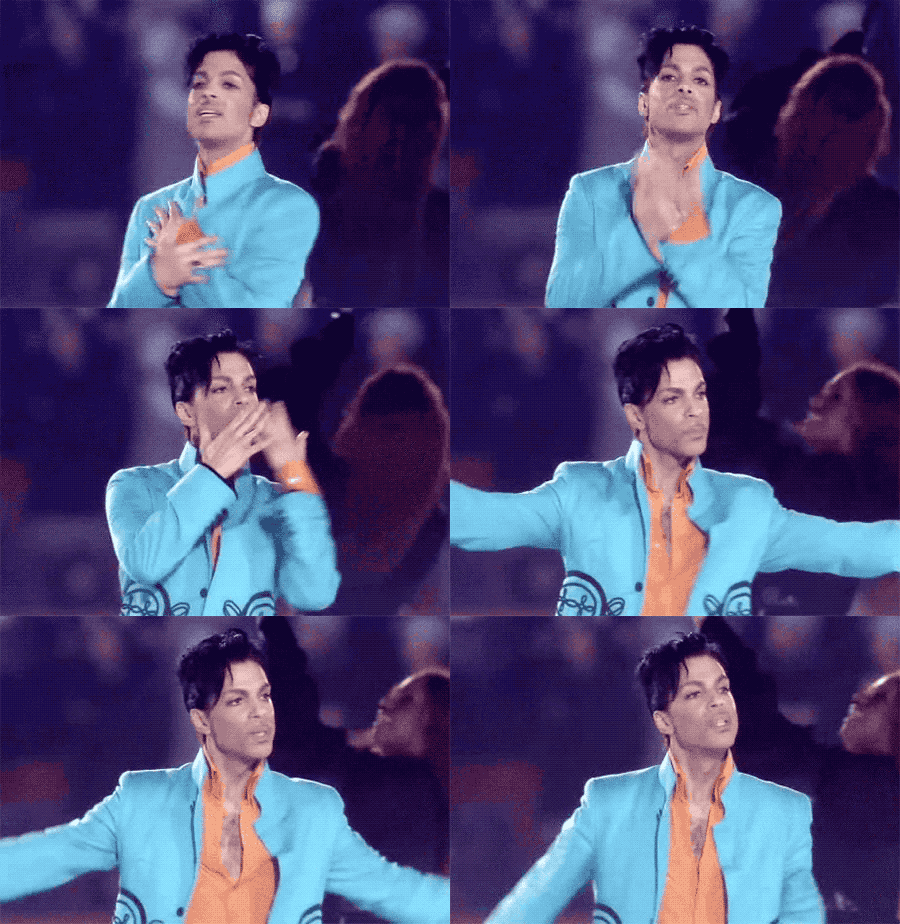
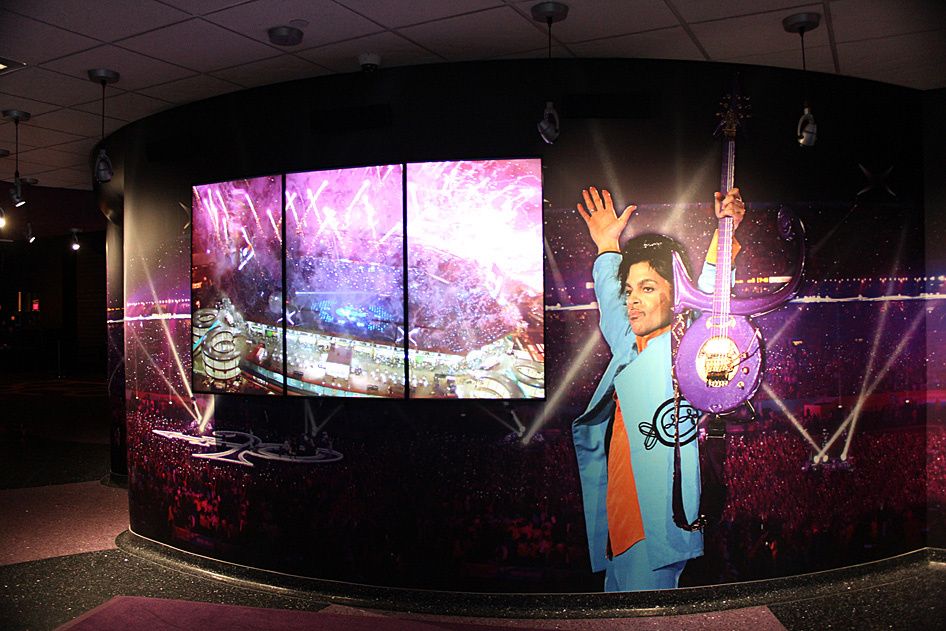
Prince was justifiably proud of his Super Bowl triumph. A week later, he aired a thank you during the Grammys for the overwhelming response. Today, at Paisley Park there’s a complete commemoration of the performance, including the ability to watch it in its entirety.
That tribute to the halftime performance was planned by Prince himself; he had wanted to ensure it remained a permanent part of his legacy.
Further Reading
- For more context on the production of the show, this 2020 oral history of Prince's Super Bowl performance talks to many of the key people involved.
- Back in 2007, I wrote up a "Pre-Super Bowl Prince Primer" for casual fans ahead of the big game, anticipating that the performance might be a good one.
- I have, uh, written other stuff about Prince, too.